 State of the World
»Environmental Destruction
»Social & Economic Injustice
»Militarism & Conflicts
»Increasing Consumption
»Expanding Eco-Footprint
»Third World Debt Good News Concious Choices
»Actions To Take
 | 
| SOCIAL & ECONOMIC INJUSTICE Socially and economically we have created great disparities of wealth with a minority of the world's population (17%) consuming most of the world's resources (80%), leaving almost 5 billion people to live on the remaining 20%. As a result, billions of people are living without the very basic necessities of life of food, water, housing, sanitation, health etc. Specifically, 1.2 billion (that is 20%) of the world population now lives on less that $1/day, another 1.8 billion (30%) lives on less than $2/day, 800 million go to bed hungry every day, and 30,000 - 60,000 die each day from hunger alone. The story is the same, when it comes to other necessities like water, housing, education etc. On the flip side we have increasing accumulation of wealth and power, where the world's 500 or so billionaires have assets of 1.9 trillion dollars, a sum greater than the income of the poorest 170 countries in the world. The following table from UNDP (United Nations Development Programme) shows the millions of people living without the basic necessities of food, education, water, sanitation. 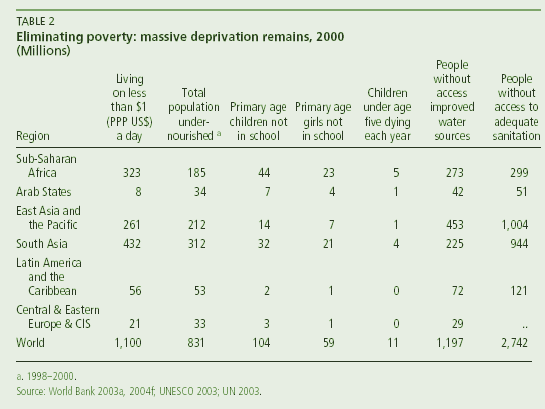
Some More Facts: Rich Man Poor Man - The amount of money that the richest 1 percent of the world's people make each year equals what the poorest 57 percent make.
- World's 358 billionaires have assets exceeding the combined annual incomes of countries with 45 percent of the world's people
- Globally, the 20% of the world's people in the highest-income countries account for 86% of total private consumption expenditures - the poorest 20% a minuscule 1.3%. More specifically, the richest fifth:
- An analysis of long-term trends shows the distance between the richest and poorest countries was about :
- The GDP (Gross Domestic Product) of the poorest 48 nations (i.e. a quarter of the world's countries) is less than the wealth of the world's three richest people combined A few hundred millionaires now own as much wealth as the world's poorest 2.5 billion people
Rich Nations, Poor Nations - 20% of the population in the developed nations, consume 86% of the worlds goods
- A mere 12 percent of the world's population uses 85 percent of its water, and these 12 percent do not live in the Third World.
- The richest 5 percent of the world's people have incomes 114 times that of the poorest 5 percent
- The combined wealth of the world's 200 richest people hit $1 trillion in 1999; the combined incomes of the 582 million people living in the 43 least developed countries is $146 billion
- The cost of providing basic health care and nutrition for all in the world would be less than is spent in Europe and the US on pet food
Rich Corporations, Poor Nations - The annual revenue of Motorola is almost equal to the annual income of Nigeria, Africa's second largest economy, almost the size of Europe and with a population of 118 million people.
Poverty, Hunger - More than 840 million people in the world are malnourished--799 million of them are from the developing world. More than 153 million of them are under the age of 5
- Hunger kills. Every day, 34,000 children under five die of hunger or preventable diseases resulting from hunger or 6 million in a year
- Of the 6.2 billion people in today's world, 1.2 billion live on less than $1 per day. Nearly 3 billion people live on less than $2 a day
- 1.2 billion lack access to clean water; 2.4 billion live without decent sanitation; and 4 billion without wastewater disposal.
- 12 million people die each year from lack of water, including 3 million children from waterborne disease: More than 113 million children in the developing world are without access to basic education; 60 percent of them are girls.
Some Resources: Did you know? Exclusion from clean water and basic sanitation claims more lives than any war or terrorist act. 2006 Human Development Report
Throughout history water has confronted humanity with some of its greatest challenges. Water is a source of life and a natural resource that sustains our environments and supports livelihoods - but it is also a source of risk and vulnerability. In the early 21st Century, prospects for human development are threatened by a deepening global water crisis. Debunking the myth that the crisis is the result of scarcity, this report argues poverty, power and inequality are at the heart of the problem. In a world of unprecedented wealth, almost 2 million children die each year for want of a glass of clean water and adequate sanitation. Millions of women and young girls are forced to spend hours collecting and carrying water, restricting their opportunities and their choices. And water-borne infectious diseases are holding back poverty reduction and economic growth in some of the world's poorest countries. Beyond the household, competition for water as a productive resource is intensifying. Symptoms of that competition include the collapse of water-based ecological systems, declining river flows and large-scale groundwater depletion. Conflicts over water are intensifying within countries, with the rural poor losing out. The potential for tensions between countries is also growing, though there are large potential human development gains from increased cooperation. The Human Development Report continues to frame debates on some of the most pressing challenges facing humanity. Human Development Report 2006: - Investigates the underlying causes and consequences of a crisis that leaves 1.2 billion people without access to safe water and 2.6 billion without access to sanitation
- Argues for a concerted drive to achieve water and sanitation for all through national strategies and a global plan of action
- Examines the social and economic forces that are driving water shortages and marginalizing the poor in agriculture
- Looks at the scope for international cooperation to resolve cross-border tensions in water management
-
Includes special contributions from Gordon Brown and Ngozi Okonjo-Iweala, President Lula, President Carter, and the UN Secretary General, Kofi Annan. Source: http://hdr.undp.org/hdr2006/ | |